Complete Guide to the 6th Arrondissement: Saint-Germain-des-Prés
A deep dive into Saint-Germain-des-Prés: literary cafés, art galleries, the Luxembourg Garden, starred tables and where to stay in Paris's most elegant Left Bank quarter.
This guide goes beyond the obvious. It is written for travellers who want to understand the 6th the way its residents do, and to live there, even briefly, as a Parisian rather than a passer-by.
Character & atmosphere
The 6th arrondissement is known for a particular kind of intelligent elegance. Where the 8th broadcasts its wealth across grand avenues and monumental facades, the 6th keeps its luxury at a human scale: narrow streets, ground-floor galleries, antiquarian bookshops, and the kind of café where a single coffee buys you an afternoon. It is the most cultured quarter in Paris, and it wears that culture lightly.
The neighbourhood's identity was forged in the mid-twentieth century, when the cafés of Saint-Germain became the headquarters of French intellectual life. Jean-Paul Sartre and Simone de Beauvoir held court at the Café de Flore and Les Deux Magots; the writers, philosophers, jazz musicians and editors who orbited them turned a few hundred metres of boulevard into the most influential square of pavement in Europe. That heritage is not a museum piece here: it is still legible in the publishing houses tucked into the side streets, the gallery openings that spill onto the pavement, and the booksellers who have outlasted every economic season.
What makes the 6th exceptional for a visitor is its density of pleasure. Within a fifteen-minute walk you can see a Botticelli, browse a Pierre Hermé macaron counter, sit in the garden where generations of Parisians have read their newspapers, and dine at a three-Michelin-starred table. Few neighbourhoods on earth pack so much beauty into so small a footprint.
Where to stay: luxury apartments in the 6th arrondissement
For travellers asking where to stay in Saint-Germain-des-Prés, the answer is almost always: as close to the centre of it as possible. The quarter rewards those who can step out of their door and into its life: a morning coffee at the Flore, an afternoon in the Luxembourg, a late dinner without a taxi.
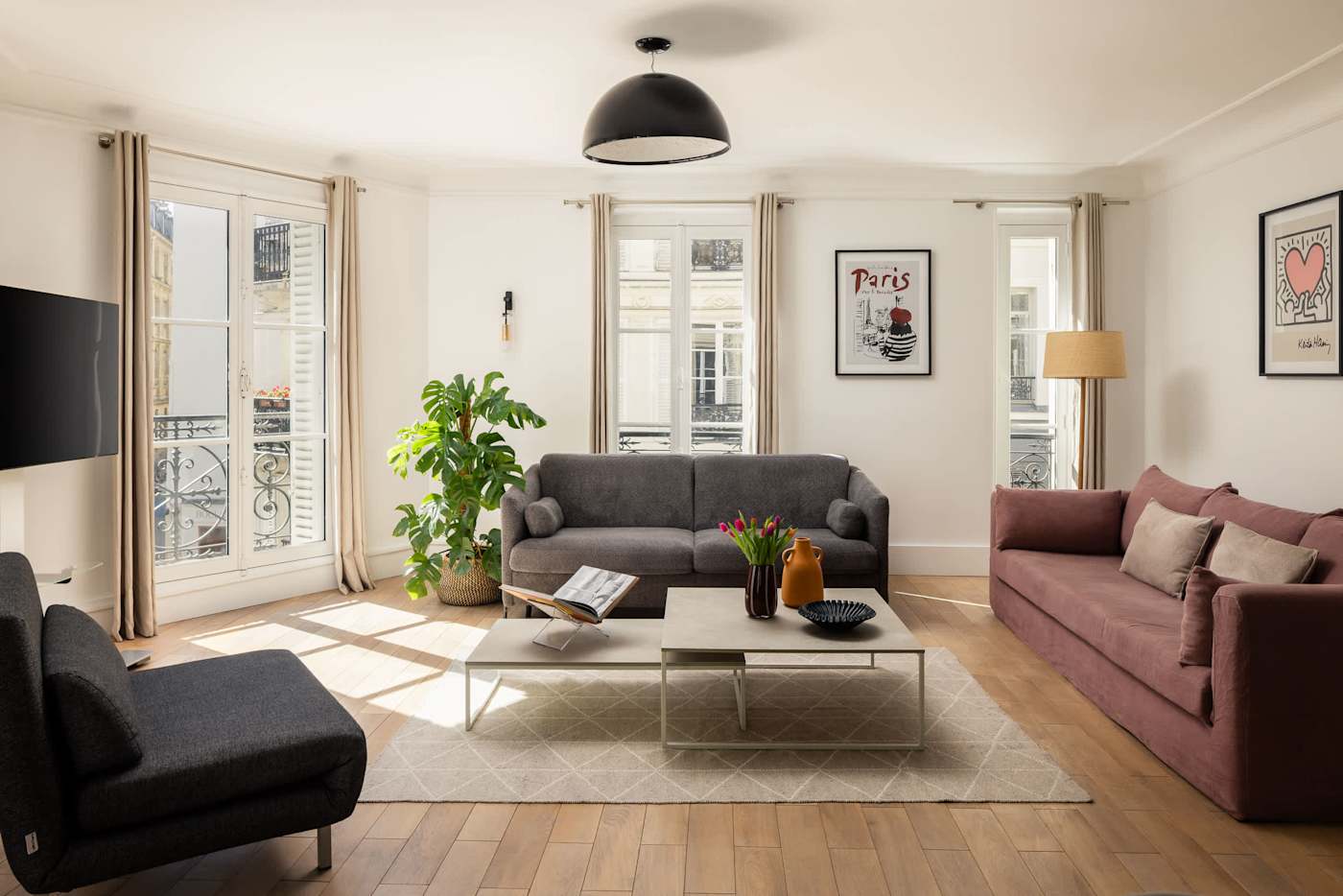
This is precisely where a serviced apartment outperforms a hotel. Saint-Germain's most desirable buildings are eighteenth- and nineteenth-century (high ceilings, herringbone parquet, tall windows opening onto courtyards or rooftops), and a well-appointed apartment lets you experience that architecture as a home rather than a lobby. You wake in a residential street, buy your bread from the same boulangerie twice, and treat the neighbourhood as your own.
The best parts of the 6th for luxury are the blocks immediately around the Église Saint-Germain-des-Prés and the streets running down toward the Seine (rue Bonaparte, rue de Seine, rue Jacob, rue de l'Université at the edge of the 7th), as well as the calmer, leafier streets near the Luxembourg Garden and the Odéon. The former puts you in the thick of the galleries and cafés; the latter offers more quiet and green, ideal for families.
Our collection of curated apartments is chosen for exactly this: space, light, and an address that places the whole quarter at your feet. Where a hotel gives you a room, an apartment in the 6th gives you a Parisian life.
Dining & cafés
The 6th arrondissement spans the full spectrum of Parisian dining, from a legendary three-star to the most famous café in the world.
The gastronomic tables
Guy Savoy - Monnaie de Paris. Three Michelin stars, set inside the historic Monnaie de Paris on the Seine quays. Guy Savoy's black-truffle artichoke and his legendary lentil soup are touchstones of modern French gastronomy; the dining rooms overlooking the river make this one of the great gastronomic experiences anywhere in the world. Reserve well ahead. OJII. An intimate, refined Japanese table in a minimalist Saint-Germain setting. The exceptional omakase is built on ultra-fresh ingredients and genuine Japanese craftsmanship, the kind of quiet, precise dinner the 6th does so well.Contemporary and convivial
Sugaar. A contemporary Basque table in the heart of Saint-Germain, where Basque Country produce is elevated with a creative touch in a warm, convivial atmosphere, a relaxed counterpoint to the formal rooms. Cherry. A trendy address blending Mediterranean and Asian flavours, with crafted cocktails and sharing plates in an elegant yet festive setting, ideal for a lively evening with friends.Cafés & patisserie
Café de Flore. The world's most famous literary café, and the spiritual centre of the quarter. Its mythical terrace is where Sartre and Beauvoir wrote history, and its hot chocolate remains legendary. Sit, order, and stay: the time is yours. Just along the boulevard, Les Deux Magots offers the same heritage and the same ritual; the gentle rivalry between the two is part of Saint-Germain folklore. Pierre Hermé. The temple of the macaron, on rue Bonaparte. The Ispahan (rose, lychee, raspberry) and the Infiniment Vanille are creations that genuinely revolutionised French patisserie. A box from here is the most elegant gift you can carry out of the 6th.Culture & landmarks
Culture is not an attraction in the 6th: it is the texture of daily life. The quarter is built around its institutions, and most of them sit within easy walking distance of one another.
Église Saint-Germain-des-Prés. The oldest church in Paris, its Romanesque tower dating to the eleventh century, gives the neighbourhood its name and its anchor. Recently restored, its painted interior is a quiet marvel often overlooked by visitors hurrying to the cafés outside. The art galleries. The streets between the church and the Seine (rue de Seine, rue Bonaparte, rue Mazarine, rue Jacob) form one of the densest concentrations of art and antique galleries in Europe. A self-guided afternoon wandering from window to window, with no fixed plan, is one of the 6th's purest pleasures. Odéon and the theatres. The Carrefour de l'Odéon and the neoclassical Théâtre de l'Odéon mark the lively eastern edge of the quarter, where cinemas, bookshops and cafés keep the streets animated well into the evening. The publishing quarter. Many of France's great publishing houses are headquartered in the 6th, and the bookshops that serve them, from venerable institutions to specialist art booksellers, make this the literary capital of the city in the most literal sense.Parks & gardens
Jardin du Luxembourg
The Luxembourg Garden is the green heart of the 6th and one of the most beautiful gardens in Paris. Created in the seventeenth century for Marie de' Medici, it surrounds the Senate's palace with formal parterres, gravel allées, tree-lined groves and the famous octagonal basin where children sail wooden boats. Parisians treat it as an outdoor living room: students read on the iconic green metal chairs, joggers circle the perimeter at dawn, and families gather around the puppet theatre and the carousel.
For a visitor staying nearby, the Luxembourg transforms a trip. It becomes the place you cross on your way to dinner, the spot you return to with a book and a pastry, the garden your children come to think of as theirs.
Best time: Early morning, when the gardeners are still raking the gravel and the light is low through the chestnut trees.Shopping
The 6th is one of the finest shopping quarters in Paris, and a far more pleasurable one than the flagship avenues across the river.
Le Bon Marché. Paris's oldest department store, founded in 1852, sits on the western edge of the 6th. More curated and more refined than its Right Bank rivals, it pairs fashion and design with La Grande Épicerie de Paris next door, the most beautiful food hall in the city, and a destination in its own right. The designer boutiques. The streets around the boulevard Saint-Germain and rue de Grenelle are lined with the boutiques of French and international houses, interspersed with independent designers, perfumers and interiors shops. The scale is intimate; the curation is impeccable. Antiques and rare books. Beyond the art galleries, the quarter is a hunting ground for antiquarian books, prints and decorative objects, the kind of considered, one-of-a-kind purchase the 6th does better than anywhere.Getting around
The 6th is compact and supremely walkable: most of its pleasures are within a fifteen-minute stroll of one another. When you need the métro or wider connections:
- · Line 4: Saint-Germain-des-Prés, Odéon, Saint-Sulpice
- · Line 10: Mabillon, Odéon, Sèvres-Babylone (for Le Bon Marché)
- · Line 12: Rennes, Sèvres-Babylone
- · RER B: Luxembourg, for direct connections to Châtelet and the airports
How the 6th compares to the 8th
Travellers often weigh the 6th against the 8th, Paris's other great luxury address. The distinction is essentially one of temperament. The 8th, home to the Golden Triangle, avenue Montaigne and the palace hotels, is the showcase of Parisian luxury at its most monumental: grand avenues, haute couture flagships, and the highest concentration of Michelin stars in the city. The 6th is luxury at human scale: cultured, residential, walkable, and woven into a living neighbourhood rather than staged along boulevards.
Put simply: choose the 8th for couture, palaces and grand spectacle; choose the 6th for galleries, gardens, literary cafés and the feeling of belonging to a real Parisian quarter. Both are exceptional. The 6th is the one most visitors fall in love with. For a closer look at its counterpart, see our complete guide to the 8th arrondissement.
Frequently asked questions
Is the 6th arrondissement a good area to stay in Paris? Yes, it is one of the best. The 6th (Saint-Germain-des-Prés) is central, safe, supremely walkable, and rich in cafés, galleries, dining and green space. It places you a short walk from the Seine, the Louvre, Notre-Dame and the Latin Quarter, making it ideal for first-time visitors and returning travellers alike. What is the 6th arrondissement known for? Saint-Germain-des-Prés is known for its literary heritage (the cafés of Sartre and Beauvoir) alongside its art galleries, designer boutiques, the Luxembourg Garden, and a refined, intellectual atmosphere. It is widely considered the most elegant and cultured quarter on the Left Bank. Is the 6th better than the 8th for luxury? It depends on the experience you want. The 8th offers monumental luxury: palace hotels, haute couture, starred restaurants along grand avenues. The 6th offers human-scale luxury: a walkable, residential, culturally rich neighbourhood. For couture and spectacle, choose the 8th; for atmosphere, gardens and living like a Parisian, choose the 6th. Is Saint-Germain-des-Prés walkable? Extremely. The 6th is one of Paris's most compact arrondissements, and nearly everything (cafés, the Luxembourg Garden, galleries, Le Bon Marché, the Seine) is within a fifteen-minute walk. A car is unnecessary and a hindrance. Where is the best place to stay in the 6th for luxury? The streets around the Église Saint-Germain-des-Prés and down toward the Seine (rue Bonaparte, rue de Seine, rue Jacob) place you in the heart of the cafés and galleries, while the leafier streets near the Luxembourg Garden and the Odéon offer more quiet and green. A spacious, well-appointed apartment in either zone is the finest way to experience the quarter.Best for
- · Couples: Literary cafés, candlelit dinners, gallery strolls and the romance of the Left Bank make the 6th one of the most seductive quarters in Paris.
- · Families: The Luxembourg Garden (with its puppet theatre, carousel and sailing pond), plus quiet residential streets and easy walking distances make family life effortless here.
- · Culture lovers: Galleries, bookshops, theatres, the oldest church in Paris and a living literary heritage put the 6th at the centre of cultured Paris.
- · Shopping: Le Bon Marché, La Grande Épicerie, designer boutiques and antiquarian dealers offer a more refined, intimate alternative to the Right Bank avenues.
- · First-time visitors: Central, safe, walkable and beautiful, with the Seine, the Louvre and the Latin Quarter on the doorstep, the 6th is arguably the ideal base for a first trip to Paris.
Staying in the 6th
To stay in the 6th is to live, for a few days, inside the Paris that writers and artists made famous, and that residents quietly treasure today. Our apartments here offer the space, light and comfort of a genuine home, set within one of the most beautiful and cultured neighbourhoods in the world.
Whether you are visiting for the galleries, the gardens, the gastronomy, or simply to walk the streets that shaped modern thought, the 6th never disappoints. And our concierge is here to open its quieter doors: a table at a starred restaurant, a private gallery viewing, a guided literary walk through Saint-Germain.
Browse our full collection →Stay in the 6th arrondissement
Ready to make this neighbourhood your own? Browse our luxury apartments in the 6th arrondissement, or explore the full Aircube collection.