Complete Guide to the 1st Arrondissement: Louvre & Palais-Royal
A deep dive into the historic heart of Paris: the Louvre, Palais-Royal, the Tuileries and Place Vendôme. Where to stay, dine, and live like a Parisian.
But the 1st is not a museum frozen in amber. Behind its monumental colonnades and royal gardens, there is a living neighbourhood: coffee that locals queue for, gardens where Parisians read in the afternoon sun, a high-jewellery square that still glitters, and a quiet residential life that surprises first-time visitors who expected only crowds. This guide is designed to reveal that fuller picture: the 1st arrondissement as those who live here know it.
Character & atmosphere
The 1st arrondissement is known for being the most central and historic district of Paris, the original heart of the city around which the rest of the capital grew. It is compact, among the smallest arrondissements by population, and almost entirely given over to grand institutions: the Louvre, the Palais-Royal, the Tuileries, the Comédie-Française, and the law courts on the Île de la Cité. The result is a quarter where the architecture is uniformly magnificent and the sense of occasion never quite fades.
The atmosphere shifts block by block. Around the Louvre and the rue de Rivoli, the energy is grand and a little theatrical, busy with visitors crossing between the Seine and the museum. A few streets north, the Palais-Royal gardens are hushed and almost secretive: a perfect rectangle of clipped limes, fountains and arcades where the noise of the city simply stops. Toward Place Vendôme and the rue Saint-Honoré, the mood turns to quiet luxury: discreet boutiques, doormen, and the murmur of serious money. And along the Seine, from the Pont Neuf to the newly reborn Samaritaine, there is a riverside calm that feels almost provincial.
How does the 1st compare to its famous neighbours? Where the 8th arrondissement is the showcase of haute-couture flagships and palace hotels, and the 6th (Saint-Germain-des-Prés) trades on literary cafés and Left Bank bohemia, the 1st is defined by history and proximity. You are not near the landmarks here: you are inside them. Nowhere else in Paris can you wake, cross a royal garden, and stand before the Mona Lisa before the first tour groups arrive. For visitors who want the whole city within walking distance, the 1st is unmatched.
Where to stay - luxury apartments in the 1st arrondissement
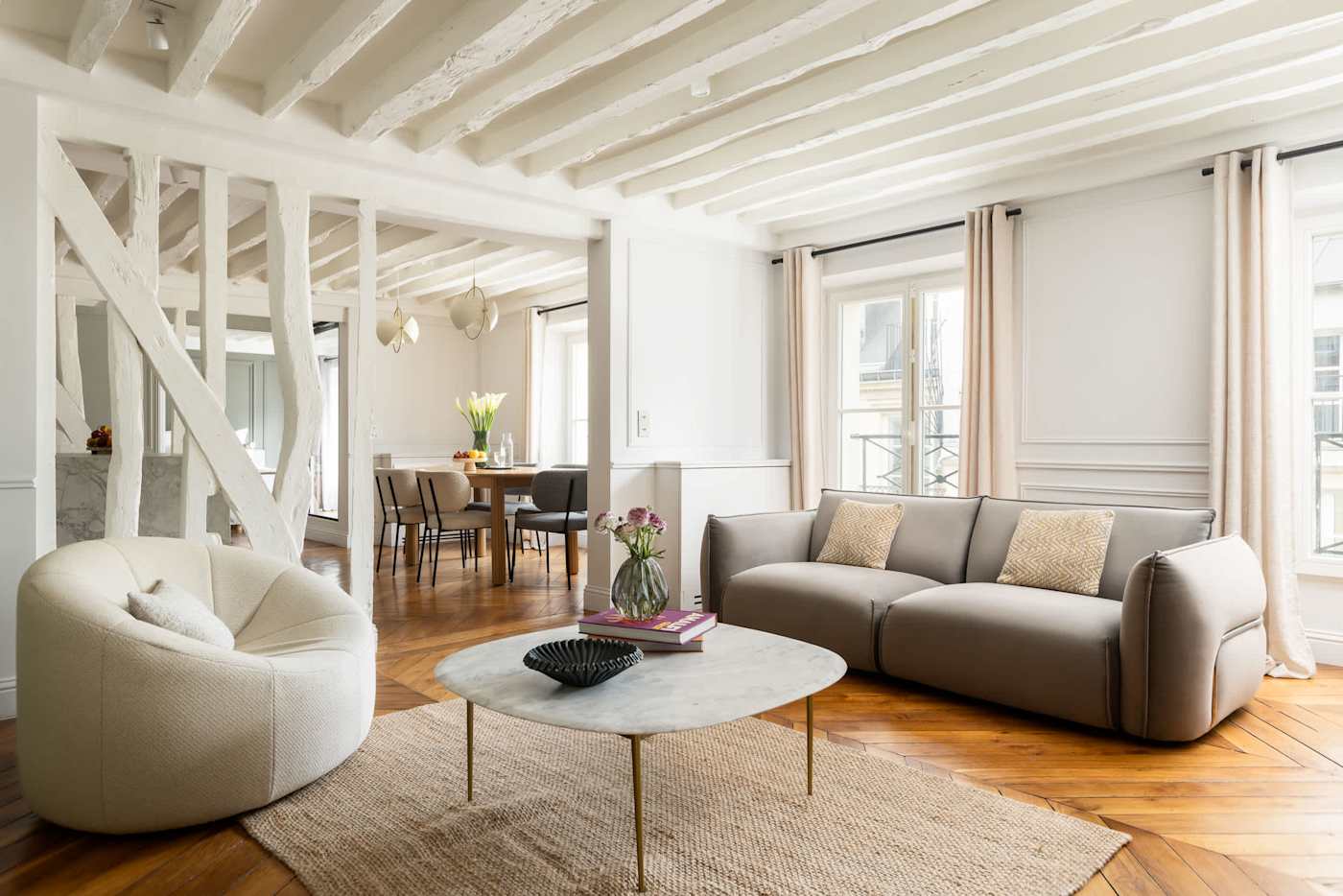
The best way to experience the 1st arrondissement is not from a hotel lobby but from a home of your own: a quiet apartment behind a porte cochère, with tall windows, parquet floors and the bells of Saint-Germain-l'Auxerrois drifting in at dawn. Staying in an apartment means living the neighbourhood at its own rhythm: a morning coffee at the same café, a basket of pastries carried back through the Tuileries, an evening that ends with the Louvre lit up against the night sky rather than with a taxi back across town.
When deciding where to stay in the 1st arrondissement, it helps to think in micro-quarters:
- · Around the Palais-Royal: the most romantic address in the district. Calm, central, surrounded by gardens, fine dining and the Comédie-Française. Ideal for couples and culture lovers.
- · Near the Louvre and rue de Rivoli: maximum convenience, steps from the museum and the métro, with the Tuileries on your doorstep. Best for first-time visitors who want everything within reach.
- · Toward Place Vendôme and rue Saint-Honoré: the quietest and most exclusive pocket, made for shopping and slow luxury.
- · Along the Seine, near the Pont Neuf and the Samaritaine: riverside light, postcard views, and a calmer pace.
Dining & cafés
The 1st arrondissement holds some of the most storied tables in Paris alongside a wave of confident newcomers. Whether you want a gilded, once-in-a-lifetime dinner or simply the best matcha latte of your trip, the neighbourhood delivers.
The destination tables
Le Grand Véfour is the grande dame of the district: a two-Michelin-star restaurant set beneath the arcades of the Palais-Royal, in a listed 18th-century dining room of mirrors, painted panels and red velvet. Diners from Napoleon to Colette have sat here; the refined French cuisine is matched by one of the most beautiful settings in all of Paris. This is the address for a milestone dinner. Langosteria, the Parisian outpost of Milan's celebrated seafood house, brings a dose of Italian dolce vita to the quarter: refined Italian seafood, shellfish pastas and an atmosphere of effortless glamour. It is the perfect counterpoint to a classical French evening: lighter, warmer, and unmistakably stylish.Cafés and pastry
Café Kitsuné is the neighbourhood icon, nestled in the gardens of the Palais-Royal. Its matcha latte and refined Japanese aesthetic have made it a pilgrimage, and the setting (a tiny counter opening onto one of the most beautiful gardens in Paris) is reason enough to visit. It is the ideal pause between two museum rooms.For something closer to art than breakfast, Cédric Grolet Opéra is the most photographed patisserie in Paris. Grolet's trompe-l'œil fruits (a "lemon" that is in fact a flawless dessert, a "hazelnut" hiding praline) are edible sculptures. Expect to queue; consider it part of the ritual.
A drink to end the night
Bar Omii, the cocktail bar at the Kimpton St Honoré, is the neighbourhood's quiet luxury at night: an intimate, warm room with creative Asian-inspired cocktails and a rooftop view across the Paris skyline. It is the kind of place that turns a good evening into a memorable one, close enough to walk home.Culture & landmarks
No neighbourhood in Paris, perhaps in the world, concentrates more culture per square metre than the 1st.
The Louvre
The Musée du Louvre is the largest art museum on earth and the gravitational centre of the arrondissement. Beyond the Mona Lisa and the Venus de Milo, it rewards the unhurried: the Egyptian antiquities, the Richelieu wing's French sculpture courts, the Napoleon III apartments. Staying nearby is a quiet superpower: you can visit in the early evening, when the crowds thin, and return another day for a single wing rather than trying to conquer it all at once.
Palais-Royal
The Palais-Royal is the district's secret heart. Its garden, a serene rectangle of arcades, fountains and clipped trees, is one of the most peaceful places in central Paris, and the courtyard's black-and-white Colonnes de Buren are a beloved photo stop. The arcades shelter historic boutiques, perfumers and the Grand Véfour. Few visitors realise that just steps from the Louvre's chaos lies this pocket of total calm.
The Tuileries
The Jardin des Tuileries, laid out in the 17th century by André Le Nôtre, stretches from the Louvre to the Place de la Concorde. It is Paris's grandest formal garden (gravel paths, statuary, ornamental basins where children sail toy boats) and the natural spine of the neighbourhood. The green metal chairs around the fountains are public and free; claiming one in the afternoon sun is a quintessential Parisian pleasure.
Place Vendôme and Saint-Germain-l'Auxerrois
Place Vendôme, designed under Louis XIV, is one of the most perfect architectural squares in Paris and the world capital of high jewellery: Cartier, Van Cleef & Arpels, Boucheron and Chaumet all keep historic addresses around its column. Nearby, the church of Saint-Germain-l'Auxerrois, the former royal parish facing the Louvre, rewards a quiet visit for its Gothic façade and stained glass.Shopping
The 1st arrondissement is a serious shopping destination, but a more discreet one than the avenues of the 8th.
La Samaritaine is the headline: the legendary department store, magnificently restored by LVMH, with its Art Nouveau and Art Deco architecture, luxury boutiques and panoramic views over the Seine. Even if you buy nothing, the building itself is worth the visit.From there, the rue Saint-Honoré runs east-to-west through the arrondissement as one of the great fashion streets of Paris: a parade of boutiques, concept stores and ateliers that is more Parisian and more confidential than Avenue Montaigne. And Place Vendôme remains the address for high jewellery and watchmaking. Together they make the 1st a place where you can shop for an afternoon and never leave the same few elegant blocks.
Getting around
The 1st is one of the best-connected and most walkable districts in Paris. Its compact size means most of what you came for is within a 10-15 minute stroll.
- · Métro Line 1 runs east-west through the heart of the arrondissement, with stations at Louvre-Rivoli, Palais Royal-Musée du Louvre, Tuileries and Concorde, putting the entire Right Bank axis at your door.
- · Lines 7 and 14 (Pyramides, Châtelet) and the major RER and métro hub at Châtelet-Les Halles make the rest of the city and the airports easy to reach.
- · On foot, you can walk from the Louvre to Place Vendôme in about ten minutes, or follow the Seine to Notre-Dame and the Île de la Cité in fifteen.
Frequently asked questions
Is the 1st arrondissement a good area to stay in Paris? Yes: for first-time visitors and culture lovers it is arguably the best. The 1st is the most central district in Paris, putting the Louvre, the Tuileries, Place Vendôme and the Seine within a short walk, and connecting easily to the rest of the city by métro Line 1. It is safe, beautiful and walkable, with a quieter residential life than its monuments suggest. Is the 1st arrondissement expensive? It is one of the most prestigious and sought-after addresses in Paris, so accommodation and dining sit at the higher end. That said, the value lies in location: staying in a well-chosen apartment here can mean fewer taxis, no wasted travel time, and the ability to experience the city's greatest sights at quiet hours. How does the 1st compare to the 8th or the 6th? The 8th is about haute-couture flagships and palace hotels; the 6th (Saint-Germain) is about literary cafés and Left Bank charm. The 1st is about history and centrality: you stay inside the landmarks rather than near them. For sheer proximity to the icons of Paris, the 1st wins. What is the 1st arrondissement best known for? The Louvre Museum, the Palais-Royal and its gardens, the Jardin des Tuileries, Place Vendôme's high jewellery, and the restored Samaritaine department store. It is the historic and royal heart of the city. How many days should I spend in the 1st? You could spend an entire trip here and never run out, but two to three unhurried days let you do the Louvre properly, linger in the Tuileries and Palais-Royal, shop the rue Saint-Honoré, and dine well. Staying in an apartment makes that slower rhythm possible.Best for
- · Couples: the Palais-Royal gardens, a candlelit dinner at Le Grand Véfour, and evening walks along the floodlit Louvre make the 1st one of the most romantic places in Paris.
- · Families: toy boats on the Tuileries basins, wide open gardens, and the world's greatest museum on the doorstep, all within easy walking distance.
- · Culture lovers: quite simply unbeatable, with the Louvre, the Comédie-Française, the Palais-Royal and centuries of history at every corner.
- · Shopping: the rue Saint-Honoré, Place Vendôme's high jewellery, and the restored Samaritaine make for refined, walkable retail.
- · First-time visitors: the most central base in Paris, with the city's icons and best transport links all within reach.
Stay in the 1st arrondissement
Ready to make this neighbourhood your own? Browse our luxury apartments in the 1st arrondissement, or explore the full Aircube collection.