Complete Guide to the 16th Arrondissement: Trocadéro & Passy
A deep dive into the 16th arrondissement: the finest Eiffel Tower view, Passy's refined village life, museums, the Bois de Boulogne and where to stay in luxury.
This guide goes beyond the obvious. It is written for travellers who want to understand the 16th the way its residents do, and to live there, even briefly, as a Parisian rather than a passer-by.
Character & atmosphere
The 16th arrondissement is known for being the home of the Parisian haute bourgeoisie: spacious Haussmannian apartments, private mansions, embassies, and a calm, almost provincial sense of belonging that is rare so close to the centre of a capital. It is the largest residential arrondissement in Paris, and it feels less like a single neighbourhood than a collection of villages (Trocadéro, Passy, Auteuil, La Muette), each with its own market, its own church square, its own rhythm.
What defines the 16th above all is the view. From the Trocadéro esplanade, Paris offers its most iconic image of itself: the Eiffel Tower rising directly across the Seine, framed by the fountains of the Jardins du Trocadéro. It is the single most photographed panorama in the city, and yet the streets just behind it remain serene: a residential calm that lets you watch the most famous skyline in the world without ever feeling you are in a tourist quarter.
The atmosphere is one of understated affluence. Passy, the historic heart of the arrondissement, was once a spa village outside the city walls, and it has kept a village's intimacy: the rue de Passy is a genuine shopping street rather than a luxury showcase, lined with boutiques, cafés and food shops where residents are known by name. Auteuil, further south, is leafier still, its quiet streets dotted with Art Nouveau facades by Hector Guimard. This is Paris lived in, not Paris performed.
Where to stay: luxury apartments in the 16th arrondissement
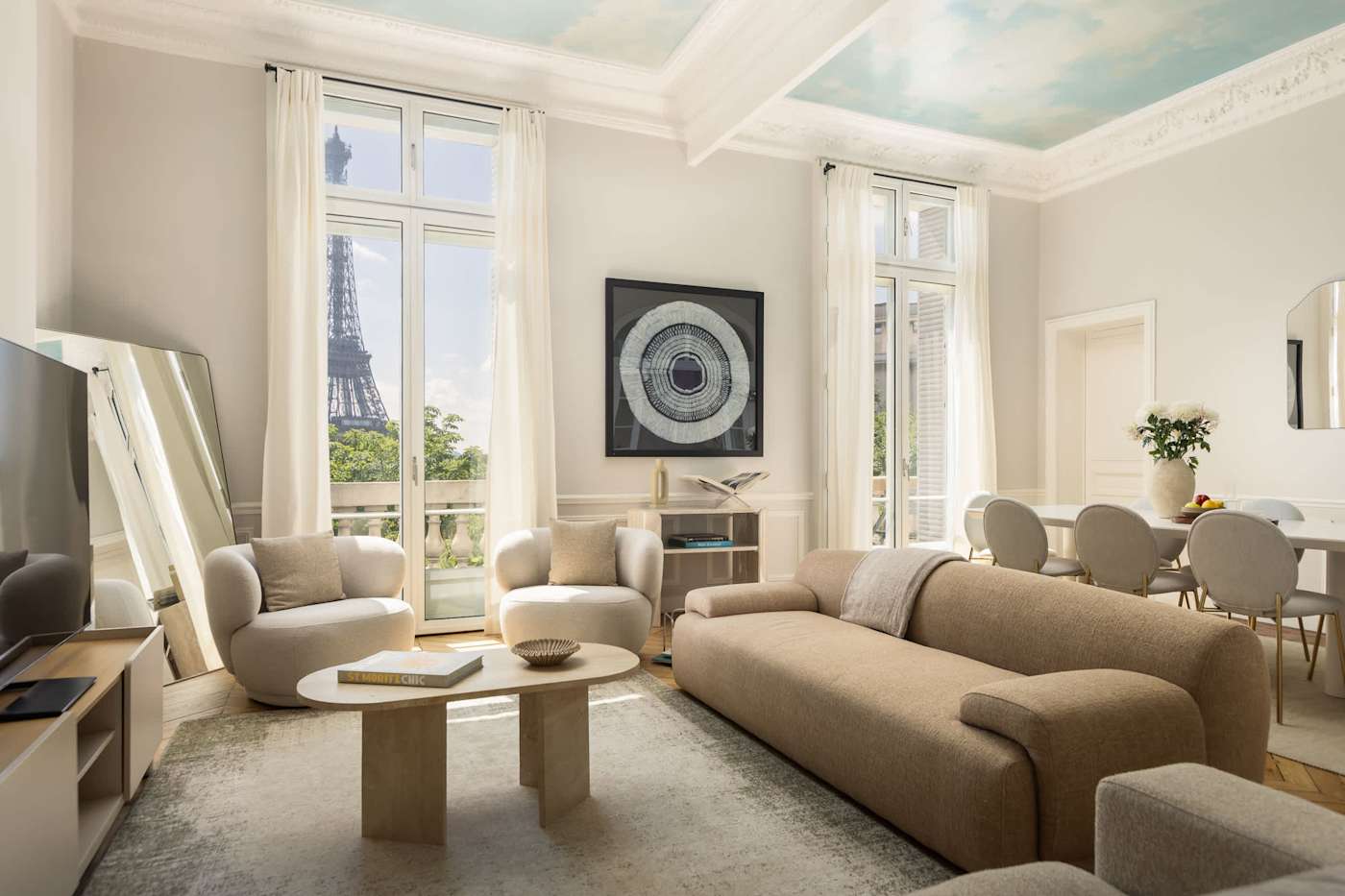
For travellers asking where to stay in Passy or Trocadéro, the appeal of the 16th is precisely its residential character. You are not staying in a district built for visitors; you are borrowing, for a few days, the life of a Parisian family in one of the city's most coveted addresses, with the Eiffel Tower as your neighbour and a real neighbourhood at your door.
This is exactly where a serviced apartment outperforms a hotel. The 16th is defined by its architecture: grand Haussmannian buildings with high ceilings, parquet floors and tall windows, many of them giving onto the Seine, the Trocadéro gardens, or the Tower itself. A well-appointed apartment lets you experience that architecture as a home: to wake to that view, to buy your bread from the same boulangerie on the rue de Passy, to treat the quarter as your own rather than passing through a lobby. For families and longer stays in particular, the space and quiet of the 16th are unmatched among the luxury arrondissements.
The best parts of the 16th for luxury fall into a few distinct zones. The streets around the Trocadéro (avenue du Président-Wilson, avenue Kléber, the heights of Chaillot) offer the Eiffel Tower views and the grandest apartments. Passy and the rue de Passy put you in the thick of village life, with shops and markets at your feet. La Muette and Auteuil, closer to the Bois de Boulogne, offer the greenest, calmest setting, ideal for families who want space and parkland.
Our collection of curated apartments is chosen for exactly this: light-filled rooms, generous space, and addresses that place the most refined Paris, and often its most famous view, right outside the window. Where a hotel gives you a room, an apartment in the 16th gives you a Parisian life.
Dining & cafés
Dining in the 16th divides neatly between two pleasures: spectacular tables built around the Eiffel Tower view, and the quiet, high-quality neighbourhood restaurants where residents actually eat.
The starred tables
Shang Palace - Shangri-La. One Michelin star, and the only starred Chinese restaurant in France. Set within the sumptuous Shangri-La, once the residence of Prince Roland Bonaparte, it serves exceptional dim sum and Peking duck in a setting of carved screens and jade-coloured columns, with the Eiffel Tower close at hand. It is a singular experience, with no equivalent in the city. Comice. A creative Franco-Canadian table with one Michelin star, tucked into a quiet Passy street. The surprising tasting menu, the natural-wine cellar and the intimate dining room make this the kind of refined, personal dinner the 16th does so well: far from the spectacle, deep in the residential heart of the quarter.Tables with a view
Café de l'Homme. A panoramic terrace within the Palais de Chaillot at the Trocadéro, with a head-on, full-frontal view of the Eiffel Tower. Sunday brunch and sunset cocktails here are an institution: this is, quite simply, the ultimate photo spot in Paris, paired with assured brasserie cooking. Girafe. A glamorous seafood restaurant, also at the Palais de Chaillot, with a terrace facing the Tower. The royal shellfish platter, the champagne and the unforgettable sunset make it one of the city's great occasion dinners: book the terrace, and time your reservation for golden hour.Bars & cafés
Le Bar du Shangri-La. Signature cocktails served in Bonaparte's former residence, with sublime Eiffel Tower views from the lounge or the private terrace. It is one of the most beautiful luxury bars in Paris, and one of the most discreet, a quiet alternative to the better-known palace bars across the river.Beyond these, the rue de Passy and the streets around the place du Trocadéro are lined with the kind of well-run neighbourhood cafés and bistros that define daily life in the 16th: terraces for a morning coffee, a glass of wine before dinner, the unhurried rituals of a residential quarter.
Culture & landmarks
The 16th holds one of the densest concentrations of museums in Paris, with a particular strength in modern and contemporary art, much of it overlooked by visitors who never cross to the western side of the city.
The Trocadéro and the Palais de Chaillot. The monumental Palais de Chaillot frames the Eiffel Tower view and houses several museums, including the Cité de l'Architecture. Its esplanade and the cascading Jardins du Trocadéro are the symbolic heart of the arrondissement, and the place every visitor returns to at least once for the panorama. Palais de Tokyo. The largest centre for contemporary creation in Europe, with bold, often provocative exhibitions in a vast 1937 building on the avenue du Président-Wilson. Open late, raw in spirit, it is a striking counterpoint to the quarter's classical reserve. Musée Marmottan Monet. Home to the world's largest collection of works by Claude Monet, including Impression, Sunrise, the painting that gave Impressionism its name. Set in a former hunting lodge near the Bois de Boulogne, it is one of the most rewarding and least crowded museums in Paris. Fondation Louis Vuitton. Frank Gehry's architectural masterpiece of glass sails rises from the Bois de Boulogne, hosting world-class contemporary art exhibitions in a spectacular, light-filled building. It is reason enough on its own to spend a day in the western reaches of the 16th.The arrondissement also holds the Musée Guimet of Asian arts, the Musée d'Art Moderne de Paris and the Maison de Balzac, among others: a cultural density that quietly rivals the more famous museum quarters across the Seine.
Shopping
Shopping in the 16th is residential rather than spectacular, and all the more pleasurable for it. The rue de Passy is the arrondissement's commercial spine: a genuine shopping street where fashion boutiques, the Passy Plaza centre, food shops and the Marché de Passy serve a discerning local clientele. It is the place to shop the way residents do, without the crowds or the theatre of the Right Bank avenues.
Around the place Victor Hugo and along the avenue Victor-Hugo, you will find a refined cluster of fashion, jewellery and homeware boutiques, along with some of the best food artisans in the city: bakers, cheesemongers, chocolatiers and wine merchants who supply the neighbourhood's well-stocked kitchens. For visitors staying in an apartment, these markets and food shops are part of the pleasure: the 16th makes it easy and delightful to cook, host and live as a Parisian.
Getting around
The 16th is large, so the métro and a willingness to walk are both useful. The quarter is well served:
- · Line 6: Trocadéro, Passy (with its open-air viaduct view of the Tower), Bir-Hakeim
- · Line 9: Trocadéro, La Muette, Rue de la Pompe, Jasmin
- · Line 2: Victor Hugo, Charles de Gaulle-Étoile
- · RER C: Avenue du Président-Kennedy, Maison de Radio France, for the Seine-side quays and direct links across the city
How the 16th compares to the 7th and 8th
Travellers often weigh the 16th against the 7th and the 8th, Paris's other great refined addresses. The distinction is one of temperament. The 8th, with the Golden Triangle, avenue Montaigne and the palace hotels, is luxury as monumental spectacle, staged along grand avenues for the world to admire. The 7th, just across the Seine, shares the Eiffel Tower and the residential calm but mixes in the monumental museums and the institutional grandeur of the Invalides.
The 16th is the most purely residential of the three. It offers the same proximity to the Tower as the 7th (arguably the better view, from the Trocadéro), but with more space, more green, and a deeper sense of village life. Where the 8th broadcasts wealth, the 16th lives it quietly. Put simply: choose the 8th for couture and palace spectacle, the 7th for monuments and museums on the Tower's doorstep, and the 16th for the calmest, most residential luxury and the finest view of the Eiffel Tower in the city. For a closer look at one of its counterparts, see our complete guide to the 8th arrondissement.
Frequently asked questions
Is the 16th arrondissement a good area to stay in Paris? Yes: it is one of the most refined and safest areas in the city. The 16th (Trocadéro, Passy, Auteuil) is residential, calm, and elegant, with the finest Eiffel Tower view in Paris, excellent museums, the Bois de Boulogne, and easy métro links to the centre. It is especially well suited to families, longer stays, and travellers who want space and quiet over central bustle. What is the 16th arrondissement known for? The 16th is known as the home of the Parisian upper class, for the Trocadéro's iconic view of the Eiffel Tower, for its museums (Palais de Tokyo, Musée Marmottan Monet, Fondation Louis Vuitton), for the village life of Passy, and for the Bois de Boulogne. It is the most residential and discreet of Paris's luxury arrondissements. Where is the best place to stay in Passy or Trocadéro? The streets around the Trocadéro (avenue du Président-Wilson and the heights of Chaillot) offer the grandest apartments and the Eiffel Tower views. Passy and the rue de Passy place you in the heart of village life, while La Muette and Auteuil, near the Bois de Boulogne, offer the greenest, calmest setting for families. Is the 16th better than the 8th for luxury? It depends on the experience you want. The 8th offers monumental luxury: palace hotels, haute couture, starred restaurants on grand avenues. The 16th offers residential luxury: space, calm, green, and the best Eiffel Tower view in the city. For couture and spectacle, choose the 8th; for a quiet, family-friendly base with an iconic view, choose the 16th. Does the 16th arrondissement have a good view of the Eiffel Tower? The finest in Paris. The Trocadéro esplanade, directly across the Seine from the Tower, offers the most iconic and most photographed view of the monument anywhere in the city, and many apartments on the Chaillot heights enjoy that same panorama from their windows.Best for
- · Families: Space, quiet, parkland in the Bois de Boulogne, and a safe, residential setting make the 16th one of the easiest luxury quarters in Paris for families with children.
- · Couples: Sunset cocktails over the Eiffel Tower at the Trocadéro, intimate starred dinners in Passy and riverside walks make for a quietly romantic stay.
- · Art and culture lovers: Palais de Tokyo, Musée Marmottan Monet, the Fondation Louis Vuitton and Musée Guimet put a world-class, uncrowded cultural circuit on your doorstep.
- · The view: Nowhere in Paris offers a better Eiffel Tower panorama than the 16th: the Trocadéro is the definitive vantage point, and many apartments share it.
- · Longer stays: Generous apartments, real neighbourhood shopping on the rue de Passy, and a calm residential rhythm make the 16th ideal for those settling in for weeks rather than days.
Staying in the 16th
To stay in the 16th is to live, for a few days, in the Paris that residents quietly treasure: refined, residential, and crowned by the most famous view in the city. Our apartments here offer the space, light and comfort of a genuine home, set within one of the most elegant and liveable neighbourhoods in the world.
Whether you are visiting for the museums, the view, the calm of the Bois de Boulogne, or simply to live like a Parisian on the city's most coveted western avenues, the 16th never disappoints. And our concierge is here to open its quieter doors: a table at a starred restaurant, a sunset terrace facing the Tower, a private viewing at the Fondation Louis Vuitton.
Browse our full collection →Stay in the 16th arrondissement
Ready to make this neighbourhood your own? Browse our luxury apartments in the 16th arrondissement, or explore the full Aircube collection.